Yin Yang Shadow Box: A Designer's Review for Embroidery Projects
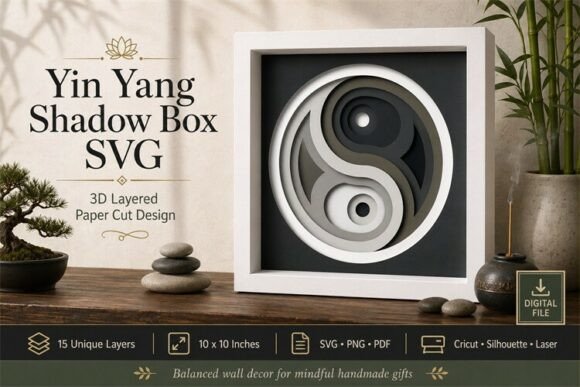
As a designer who spends more time staring at stitch maps than most people spend looking at their phones, I approach every new machine embroidery design with a mix of excitement and skepticism. We've all been there: you download a file that looks stunning on the screen, only to find it turns into a puckered mess or a tangled bird's nest once it hits the fabric. Recently, I got my hands on the Yin Yang Shadow Box, specifically the 3D SVG version marketed for layered papercut art, and I immediately wanted to see how this concept translates when adapted for thread. The promise of "embracing balance and harmony" is great for marketing, but does the geometry hold up under the tension of a needle?
First Impressions: Geometry Meets Texture
The first thing that strikes you about the Yin Yang Shadow Box concept is its reliance on depth. In the world of paper crafting, this is achieved through fifteen distinct layers of cardstock. For us embroiderers, this presents a fascinating challenge. How do we replicate that 3D effect without the physical stacking of paper? The answer lies in understanding the stitch density and the interplay of light and shadow created by different thread types.
Visually, the design exudes a modern, zen-like mood. It isn't cluttered; it relies on the iconic symbol of duality to do the heavy lifting. When I loaded the preview, the layout felt balanced, with clean lines defining the separation between the opposing forces. For an embroidery project, this clarity is crucial. If the curves are too tight or the transitions too abrupt, the machine will struggle, and the finished product will look amateurish. Fortunately, the core shape of the Yin Yang is forgiving, allowing for smooth satin stitch borders or dense fill stitch areas that can mimic the shadowed layers of the original papercut inspiration.
Real-World Application: From Screen to Sweatshirt
To truly test the viability of this design, I imagined a specific scenario: a custom order for a local yoga studio owner who needed branded custom apparel. She wanted something subtle yet recognizable for a line of organic cotton sweatshirts. This is where the Yin Yang Shadow Box shines. Unlike a flat, one-color logo, this design invites texture.
If you are an Etsy seller or run a small shop product line, versatility is your best friend. I could see this working beautifully as a large back-piece on a hoodie, where the "layers" are simulated by using varying shades of grey or black thread to create a gradient effect. Alternatively, for a tote bag design, you could use a contrasting thread color to make the symbol pop against a canvas background. The key here is adaptation. While the source material is a Shadow Boxes style SVG intended for cutting machines, the visual language translates well to embroidery if you adjust your approach to thread weight and stitch direction.
For those creating personalized gifts or holiday embroidery items, consider the recipient. A baby onesie with a simplified version of this motif makes for a thoughtful baby embroidery project, symbolizing balance in a new life. However, scale is everything. What works on a pillow cover might overwhelm a cap or a small embroidered patch.
Navigating Technical Challenges
Let's get practical. Taking a design inspired by 15-layer papercut art and converting it into a viable digital embroidery file requires caution. The original description mentions "15 Layered Papercut Art," which implies extreme detail. In embroidery, excessive detail on small areas can lead to breakage or poor coverage.
- Fabric Texture: On textured fabrics like terry cloth or heavy wool, fine details can get lost. If you are attempting this on a kitchen towel or a thick blanket, ensure the stitch count is high enough to cover the loops of the fabric.
- Stretchy Fabric: Applying a dense design to a stretchy t-shirt or leggings requires a robust stabilizer. Without it, the "shadow" effect will distort as the fabric moves, ruining the symmetry essential to the Yin Yang.
- Dark Fabric: If stitching on black or navy, remember that the "shadow" layers in the original design might disappear. You may need to introduce a lighter underlay or change the thread palette to maintain the 3D illusion.
- Curved Surfaces: Placing this on a baseball cap is tricky. The curvature of the front panel can distort the circular nature of the symbol. It is often better to place such geometric designs on flat surfaces like aprons or pillow covers unless you have significant experience with cap framing.
Furthermore, be wary of tiny lettering if the design includes text elements (though the core symbol usually stands alone). Small details near the curved intersections of the Yin Yang need careful digitizing to prevent thread bunching.
Enhancing Brand Value and Visual Appeal
Why choose this over a standard flat logo? The answer is perceived value. A design that mimics depth and complexity, like the Yin Yang Shadow Box, elevates a handmade product from a simple commodity to a piece of art. For commercial embroidery clients, this level of detail suggests professionalism and attention to craft.
When customers see a design that plays with light and shadow through thread variation, it builds trust. It shows that the maker understands not just how to run a machine, but how to manipulate materials to create an effect. This is vital for boutique branding. Whether you are selling design assets or finished goods, the visual impact of a well-executed Yin Yang can increase buyer engagement. It stops the scroll on social media and draws the eye in a craft fair setting.
Designer Notes and Best Practices
Before you commit to a full production run or list this as a new item in your shop, here are my non-negotiable steps for reviewing any new file, including adaptations of the Yin Yang Shadow Box:
- Test on Scrap: Never stitch directly on the final garment. Use a scrap piece of the exact same fabric and stabilizer combination you plan to use.
- Check Contrast: Review your thread colors in both natural light and artificial light. What looks like a subtle shadow on your monitor might look muddy on the fabric.
- Verify Hoop Size: Ensure the design fits comfortably within your available hoop size without needing excessive re-hooping, which can lead to alignment issues.
- Mockup Testing: Create black and white mockups to see if the design holds its form without relying on color. This tests the structural integrity of the digitizing.
- Licensing Check: Since the source is described as a "3D SVG" for papercut, confirm the licensing terms before selling embroidered versions. Just because you bought the SVG doesn't automatically grant rights to sell the embroidered derivative unless specified.
In conclusion, the Yin Yang Shadow Box offers a rich visual narrative that, when carefully adapted, can become a staple in your craft business. It bridges the gap between modern graphic design and traditional textile art. By respecting the limitations of the medium and paying attention to the nuances of stitch density and fabric choice, you can transform a digital concept into a tangible symbol of harmony that resonates with customers. Just remember: in embroidery, as in the Yin Yang itself, success is all about balance.